

The Environmental Impact Analysis (EIA), completed in 2009, were approved by Ibama, which issued the Preliminary License (PL) no. 342/2010 in 2010 attesting to the viability of the project, subject to the implementation of mitigating and compensatory measures.
As part of the Belo Monte licensing process, Norte Energia is implementing a series of actions aimed at mitigating impacts and strengthening the project’s operating area. Currently, 43 initiatives are underway and another 74 have been completed, out of a total of 117 plans, programs, and projects originally planned in the Basic Environmental Project (PBA), covering control, prevention, compensation, and social and environmental measures. Additionally, one plan, 11 programs, and 30 specific projects under the Basic Environmental Plan for the Indigenous Component (PBA-CI) are under development, all of which are in the implementation phase.
We adopt continuous impact remediation processes, based on integrated management mechanisms, environmental monitoring, and ongoing dialogue with the communities involved, which is achieved through adaptive management. Mitigation actions are continually improved based on the results of monitoring programs and participatory workshops, ensuring that Norte Energia’s operations are aligned with sustainability principles and comply with legal guidelines.
Permit for Installations (PI) No. 795/2011 reinforced the continuity of these programs, covering topics such as environmental management, assistance to the affected population, urban requalification, public health, heritage enhancement, environmental monitoring and conservation of terrestrial and aquatic ecosystems.
After proving compliance with the conditions, Belo Monte obtained, on November 24, 2015, an Operating License (OL No. 1317/2015) valid for six years, allowing the start of energy generation. The renewal of the OL was requested from Ibama on July 16, 2021 and, according to current legislation, remains in force until the environmental agency responds, with continued execution and periodic monitoring of the established environmental programs.
This Operating License (OL No. 1317/2015) established 5 informative conditions and 36 specific conditions, which are divided into 71 obligations (subheadings) to be fulfilled. Below, we present the progress made in implementing these obligations through the end of 2024.
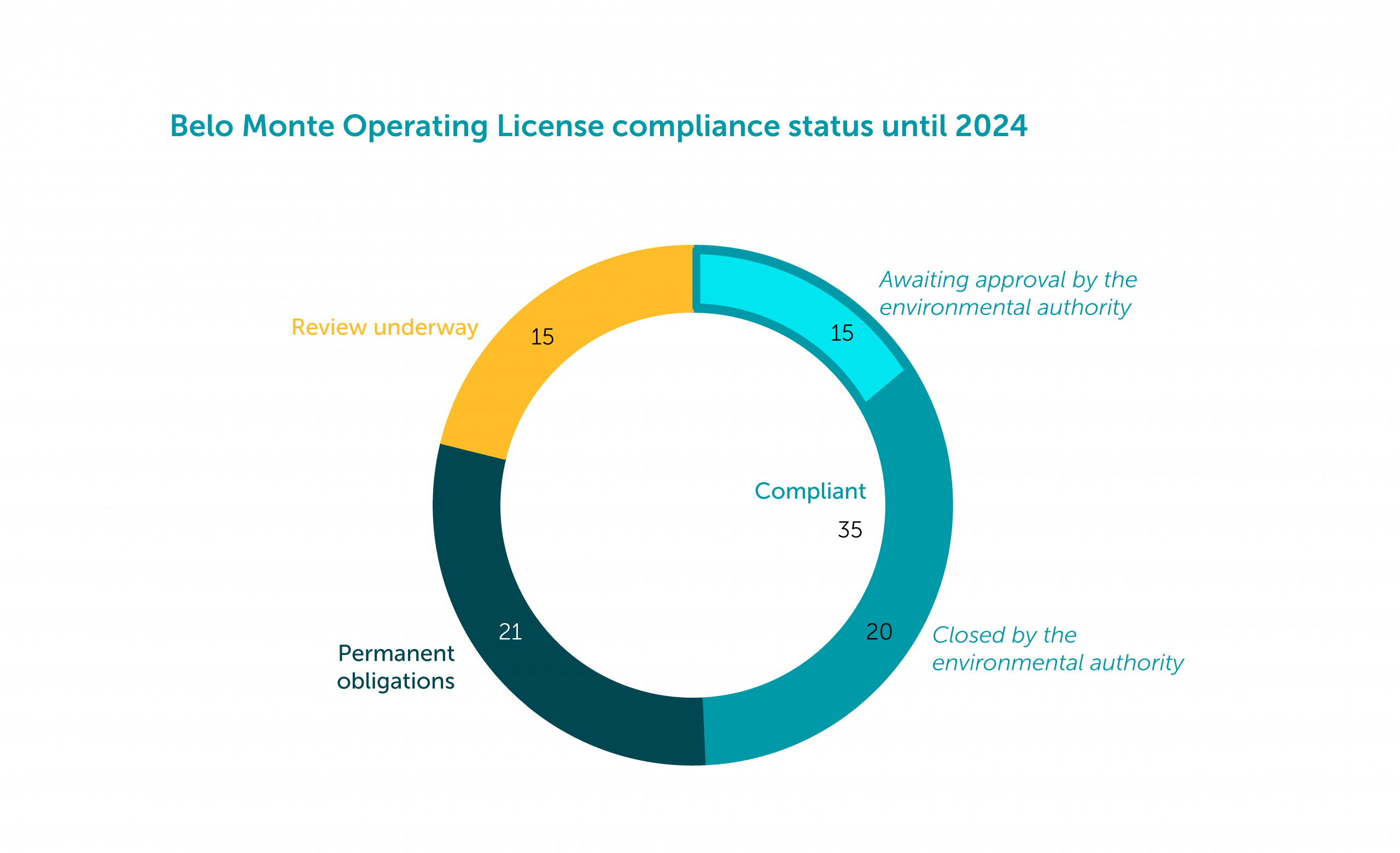
Belo Monte Operating License Compliance Status until 2024
- Review underway 15
- Awaiting approval by the environmental authority 15
- Permanent obligations 21
- Closed by the environmental authority 20
- Requirements met 35
Environmental programs and environmental licensing conditions
Belo Monte’s PBA, initiated during the construction phase, includes 117 plans, programs and projects to mitigate impacts on the physical, biotic, social, economic and cultural dimensions. Its actions cover areas such as the environment, infrastructure, social and economic development, health, education, tourism, leisure, culture and communication.
The PBA is divided into 47 social and economic initiatives, 8 measures focused on land issues and relocation, and 62 measures related to physical-biotic environment, management and construction works. It is structured into 14 plans, which are broken down into specific programs and projects. They are:
- Environmental Management Plan;
- Environmental Construction Plan;
- Plan for Assistance to the Affected Population;
- Urban Requalification Plan;
- Institutional Articulation Plan;
- Public Relations Plan;
- Public Health Plan;
- Asset Appreciation Plan;
- Geological, Geotechnical and Mineral Resources Monitoring Plan
- Water Resources Management Plan;
- Terrestrial Ecosystem Conservation Plan;
- Aquatic Ecosystem Conservation Plan;
- Integrated Management Plan for the Volta Grande do Xingu area; and
- Environmental Plan for Conservation and Use of the Reservoir Surroundings (PACUERA).
From the beginning, we have complied with environmental licensing requirements, reaffirming our actions based on transparency, respect for people and the environment, and the sustainable development of the region.
Understanding this context sheds light on the broad dimension and complexity of the interactions that were developed throughout the project’s implementation. The challenges overcome in implementing social and environmental actions and projects were based on compliance with current legislation, technical standards and, particularly, the guiding principles of human rights, in their various approaches.
Furthermore, as part of environmental and social compliance, we adopt the Performance Standards established by the International Finance Corporation (IFC), aligned with the Equator Principles (EP). These benchmarks were observed during implementation and continue to be applied in the operational phase, ensuring adherence to international best practices in social and environmental matters, health and safety at work, and with regard to impacted communities.
Since the beginning of the project’s implementation, we have been subject to independent quarterly audits to monitor compliance with the Equator Principles, without interruptions or changes in their frequency. Quarterly reports are publicly available on our website.
Norte Energia annually discloses environmental and social results through Consolidated Reports (CRs) through the Environment and Renewable Natural Resources agency (Ibama) and the Federal Indigenist Agency (Funai). In 2024, the 20th and 24th CRs on PBA and PBA-CI projects, respectively, were filed with Ibama and Funai, both referring to 2023. By January 2025, the Company had presented 48 Periodic Social and Environmental Reports, audited by independent teams in collaboration with the communities.
Social monitoring and follow-up
Norte Energia continued its Social Monitoring and Follow-Up Program for Communities Surrounding the Works and Host Communities, which aims to evaluate social and economic indicators and map the evolution of living conditions by applying the Family Development Index (FDI). The initiative focuses on those directly affected by the project and who are still involved in mitigation actions. The consolidated results for 2024 indicate stability in social and economic indicators, which confirms a transition to the current enterprise development phase.
A comparison between the 2016 and 2024 monitoring reveals a positive change in the social and economic indicators of the communities monitored by Norte Energia in the context of the environmental licensing of the Belo Monte HPP. The average FDI of monitored families increased from 0.62 in 2016 to 0.67 in 2024, demonstrating that the living conditions of monitored families were maintained. This stable trend also applies to the average percentage of families above the poverty line, which in 2013 was 84%, rising to 85% in 2024.
The improvement in these indicators demonstrates that, over time, the mitigating and compensatory measures implemented have contributed to reducing social vulnerability and promoting greater economic autonomy among our stakeholders. The importance of continuous monitoring and periodic updating of this data is also highlighted, in order to guarantee the effectiveness of actions and alignment with the region’s sustainable development objectives.
People
 2 - Zero Hunger (Target 2.1)
  3 - Good health and well-being (Target 3.3)
  4 - Quality Education (Target 4.4)
  5 - Gender Equality (Target 5.1)
  8 - Decent work and economic growth (Target 8.6)
  10 - Reduced Inequalities (Target 10.2)